
Meet Sabriye Tenberken, a German woman who is changing lives in India.
The new government has to make conscious efforts to rebuild social equality and bring the people together.

Jamida K is the first Indian Muslim woman to lead the Friday prayer.

For the first time the Ford Foundation is placed under a watch.

'In its history, the RSS has never seen success as it is seeing now. And it wants to extend their base.'

'I feel now we have a leader who is non-corruptible.' 'But he needs time as corruption is deep-rooted in our society, and people have no shame about being corrupt.' 'It will take at least 7 years to make some changes.'

'I fight for anyone who is poor, marginalised or victimised.' 'If a Dalit factory owner is inflicting atrocities on his Brahmin worker, then I will fight for the poor Brahmin.'

Socialising with people around you is actually easy and effective if done the right way.
Prime Minister Narendra Modi on range of issues -- from Rafale deal to Ram temple and triple talaq.

'We say we are proud to be Indian. Can we be proud of such an India where its people are hungry and on the streets?'

'Having dealt with security and insurgency for 15 years, I am fully convinced that the steps taken by the government in regard to J&K and the measures in force there are essential,' says B S Raghavan, the distinguished civil servant.

'In Modi's moral majority, words like security become problematic and a moral majority can turn devastatingly inquisitorial. It turns history into a preferred flatland of the nation State challenging cultural diversity in the name of majoritarianism expressed as patriotism. Dissent almost immediately becomes seditious,' says Shiv Visvanathan.

'It has even been suggested that Modi and Amit Shah, however grudgingly, harbour admiration for her controlling streak and steely resilience,' says Sunil Sethi.

'Muslims, like people of all other faiths, are quite comfortable with the idea of nationalism and democracy today. But are they following Islam in its spirit? That is a different question.'

The hounding of former AMU students by some alumni over their 'wining and dining' during Ramzan is deeply disturbing, says AMU Professor Mohammad Sajjad. 'Intolerance, irrationality, bigotry, religious/sectarian hatred, and all such pernicious tendencies must be fought and resisted, more particularly by university campuses, in order to build a better society.' 'Have we, as academics, failed, and that too, quite miserably?' he asks. 'I feel like confessing and saying yes, we have indeed failed.'
'Across the country -- in Tamil Nadu, Jharkhand, Manipur, Delhi, Bihar, West Bengal -- men were lynched on suspicion of being thieves by ordinary people armed with rods and sticks.' 'But none of these lynchings made big news.' 'None of these lynchings were cow/beef-related.' 'The perpetrators were unknown people, not so-called gau rakshaks.' 'So why were these instances of mob violence considered less newsworthy than cow-related lynchings?' asks Jyoti Punwani.

The Bharatiya Shiksha Niti Aayog will study the present education system and suggest corrective steps to make it Bharat-centric. G Sreedathan reports

Perhaps one aspect of the way modern media particularly print and news television works need some soul-searching: Their tendency to "frame" news stories as a conflict between two personalities, says Ajit Balakrishnan.

'The Congress shall have to take some brave-tough decisions to give a new social face to the party and its leadership composition,' says Mohammad Sajjad.
'Today, the target of this rage are the weaker sections of society -- Muslims, Dalits, liberal thinkers/writers who challenge its ideology. But tomorrow, it could be anyone stepping out of a pub; reading a book or watching a movie by an artist considered an anti-Hindu/anti-national,' says Durba Dhyani.

The move that comes in the backdrop of the massive controversy over alleged anti-India protests in the JNU.

Arpi deserves to be complimented for the commitment and hard work that have gone into this production. The frustrations of seeking reliable documentation from the catacombs of the Indian bureaucracy did not deter him from going after the best information available, and the result is one that he can take much satisfaction in. Ambassador Prabhat P Shukla, Member Advisory Council, Vivekananda International Foundation, reviews Claude Arpi's The End of an Era: India Exits Tibet.

'They are saying my petition is an attack on Hindu religion.' 'You pray in your home, there is no problem, but the school is a public institution run by government funds.'
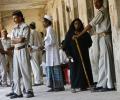
Muslims need to get out of their Isolation Syndrome, argues Mohammad Sajjad.

32 years ago, CPI-M activists hacked both the legs of Sadanandan Master, a former party member who has moved over to the RSS. Master learnt to walk using prosthetic legs and rebuilt his life. Today he is the BJP candidate highly-sensitive Koothuparamba constituency of Kannur. He told Shobha Warrier/Rediff.com his story.

'The BJP has latched on to the idea of nationalism, but the nationalism they advocate is not nationalism as we have understood it since the time of the freedom movement.' 'This is not secular nationalism, it is Hindu nationalism.' 'It is a form of nationalism that is exclusionary and it tends to conflate national interest with the government.' 'So, if you disagree with the government, for example, on surgical strikes or demonetisation, you are anti-national or holder of black money.'

'Prayers of 125 crore Indians have been answered,' said well-wishers of the former naval officer who has been incarcerated by Pakistan.

'Openness is a great weapon in the armoury of more open societies. That's why the fight with Pakistan isn't just about India be six times bigger, but equally bitter and insecure Pakistan,' argues Shekhar Gupta.
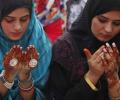
Over two dozen Muslims have been elected to the Lok Sabha. This shows that all is not lost for India's Muslims, suggests Mohammad Sajjad.

Bilawal Bhutto's political inheritance is his biggest asset as well as the biggest liability as he tries to make his mark in Pakistan politics. Challenging the Taliban militants is part of that strategy, though it matches with his political ideology. Shahzad Raza profiles the son of Benazir Bhutto and Asif Ali Zardari.
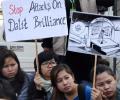
'Teachers discriminate among students based on caste, religion and gender,' says Dr Rajesh Paswan, an associate professor at JNU.

The life and work of Satyarthi is synonymous to the never-ending crusade against child slavery.
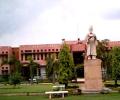
Attorney General Mukul Rohatgi's stand that AMU is not a minority university reveals the anti-minority stand of the political party now in power, says Mohammad Sajjad, outlining the long history behind one of India's premier universities.

Experts say the treaty needs a review to address the ongoing and the likely impact of climate change on river-flow

'They are not affected by ISIS' sentiment of avenging the suffering of the global ummah.' 'They have a huge ummah of their own in India, a huge Muslim population.' 'And because of that, they have to take into consideration the political and social conditions of Muslims in India.' 'They have to express themselves in a more political way and not through terrorism.'

He said that exclusion and discrimination including failure to provide security has to be corrected by the state.

'How much longer do I have?' 'How many more opportunities will I get?' Akshaye Khanna shares his worries
Of the 15 people who led the 132-year-old party post independence, four have belonged to the Gandhi-Nehru family.

'A precedent in the Rajv killers' plea for freedom may flow from slain brigand Veerappan's 2000 demand for the release of 109 associates languishing in prisons in Karnataka for him to release abducted Kannada matinee icon, the late Rajkumar.' 'Acting on a petition filed by the father of a Karnataka cadre IPS officer killed by Veerappan, the Supreme Court reversed the orders of lower court orders in Tamil Nadu and Karnataka.' 'If democratically-elected governments give an impression to the citizens of this country of being law-breakers, would it not breed contempt for the law? Would it not invite citizens to become a law unto themselves?' the Supreme Court had observed on the occasion, recalls N Sathiya Moorthy.

The President may not have agreed with the government on many occasions. Not once was this ever made public -- though he told off ministers in private.
